
Guernsey Post’s philatelic bureau has today issued a new set of stamps depicting some of the remarkable jellyfish species found in Bailiwick waters.
Featuring striking underwater photography by Sark-based photographer Sue Daly, the six stamps highlight the beauty and diversity of jellyfish regularly encountered around the islands, offering a fascinating glimpse into the marine ecosystems surrounding the Bailiwick.
Jellyfish are among the oldest living creatures in the world’s oceans, having existed for more than 500 million years. Despite their fragile, almost transparent, appearance, they are highly adapted predators that play an important role within the marine food chain. Their increasing presence in local waters may also reflect wider environmental changes, including rising sea temperatures and shifting ocean conditions.
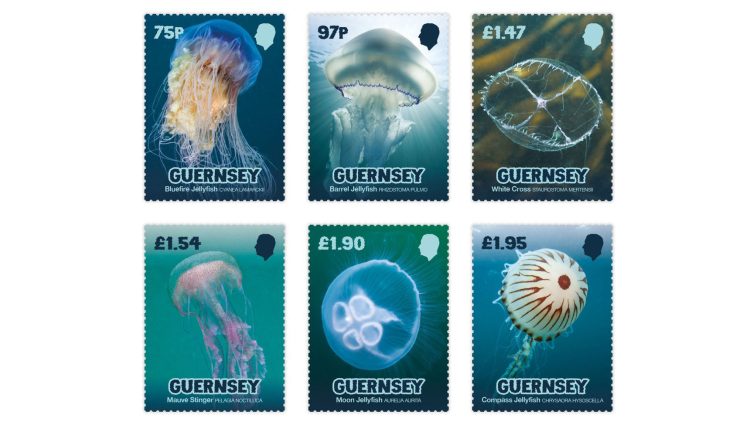
One of the most commonly encountered species in local waters, the Bluefire Jellyfish (75p stamp) is recognised by its blue or violet bell and trailing tentacles. Sometimes known as the ‘dustbin-lid jellyfish’, the Barrel Jellyfish (97p stamp) features the largest species regularly found in the region: it can grow to around 89 centimetres in diameter.
The White Cross (£1.45 stamp) is a delicate hydrozoan species named for the subtle cross-shaped pattern visible through its transparent bell. The Mauve Stinger, shown on the £1.54 stamp, is noted for its vivid colouring, bioluminescence and more powerful sting.
The Moon Jellyfish (£1.90 stamp) is easily identified by the four horseshoe-shaped rings visible through its translucent bell, while the Compass Jellyfish (£1.95 stamp) is recognised by the dark V-shaped markings radiating across its bell.
Bridget Yabsley, head of philatelic at Guernsey Post, said: “These stamps showcase some of the most fascinating and visually striking marine species found in Bailiwick waters, often glimpsed only briefly from the shoreline. Sue Daly’s photography captures the delicate beauty and unique characteristics of each jellyfish in remarkable detail.
“Jellyfish are an important part of the marine ecosystem and we hope this issue will inspire collectors and nature enthusiasts alike to take a closer interest in the
extraordinary marine life surrounding our islands.”