

I’m happy to say that me and AI are on good terms.
I use it, and I teach it to my clients. So, I’m not about to tell you to run back to the quill and ink of yesteryear. No siree!
But if you’ve opened LinkedIn or your inbox recently and thought, “This all sounds the same,” you’re not imagining it. A huge chunk of what you’re reading online has been AI‑assisted or AI‑generated.
Some estimates suggest that over half of longer English‑language LinkedIn posts now show signs of AI. And while that’s not automatically bad, a lot of it is painfully obvious.
The Channel Eye’s news team tell me it’s the same with press releases… AI is everywhere.
So let’s talk about how AI is being used in marketing, where it falls short, the tell‑tale signs of AI‑written content, and how you can use it well without sounding like a robot.
How AI is actually being used in marketing right now
Most businesses aren’t secretly asking AI to write their entire marketing strategy. They’re using it in many more everyday ways.
Press releases are a big one. Busy teams are feeding in bullet points or a link to an announcement and asking AI for a first draft. It does an impressive job of laying out the who/what/when/where/why in seconds, especially for those ‘we hired a new person’ or ‘we sponsored this thing’ stories.
Articles and blogs are another. Marketers use AI to suggest outlines, fill in background, or repurpose a webinar into a written recap. In content surveys, ‘suggest edits’ and ‘rewrite this more clearly’ are now among the most common AI use cases for writers, rather than ‘write the whole thing from scratch’.
Then there’s social content…
AI‑powered post generators for LinkedIn and other platforms are everywhere, promising 30 days of posts at the click of a button. You paste in a topic and out pops a neat hook, list, and call‑to‑action.
Used like this, AI can genuinely save time, help non‑writers get going, and tidy up clunky copy.
The problem is what happens when people copy‑paste the output, don’t edit it with their own personal tone of voice, and then do that again tomorrow. And the day after.
The tell‑tale signs of AI‑written content
People are getting surprisingly good at spotting AI content. I bet you know a few of the most obvious clangers. One recent study suggested more than 80% of consumers now feel confident they can tell when something’s been written by a machine. On LinkedIn, it’s become a bit of a sport. I’ve been known to remove connections on LinkedIn if all they spew out is AI-generated content.
Here are some of the biggest giveaways:
1. The rocket emoji
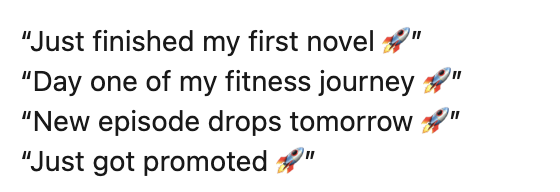
There’s nothing wrong with the occasional emoji. I use them often myself. And I’m gonna tell you I’m kind of annoyed that AI has nicked this emoji as it’s actually one of my favourites, including the flamingo 🦩 and avocado 🥑 (I don’t get to use these often as I would like). But as we’ve come to learn, AI has particular favourites, and boy does it overdo them!
The rocket 🚀, sparkles ✨ and stars ⭐ are everywhere in AI‑written LinkedIn posts.
They often show up in the same places: after ‘big news’, after ‘excited to announce’, or randomly at the end of sentences to inject ‘energy’.
this-ugcPost-7389090771649363969-LvOc
If every announcement from your very sensible firm suddenly involves ‘growth 🚀’, ‘new chapter ✨’ and ‘big news ⭐’, it starts to feel less like you and more like a template.

linkedin-posts
2. The generic tone
AI is brilliant at being smooth and inoffensive. But that’s also its biggest weakness.
AI‑generated posts and press releases often:
- Sound ultra‑positive and risk‑free.
- Avoid nuance, humour or anything that might be slightly spiky.
- Use big statements with very little specificity: “We’re passionate about innovation and customer‑centric solutions.”
You could put the same paragraph on a bank, a baker, a SaaS firm or a law firm and it would ‘sort of’ fit. So, there’s a lesson here. If, after reading your AI generated post or press release, you think, “Yeah, I think this could relate to the butcher, baker and candlestick maker down the road, it’s a red flag.”
3. Clichés and business‑speak everywhere
Now this one really makes me bawk.
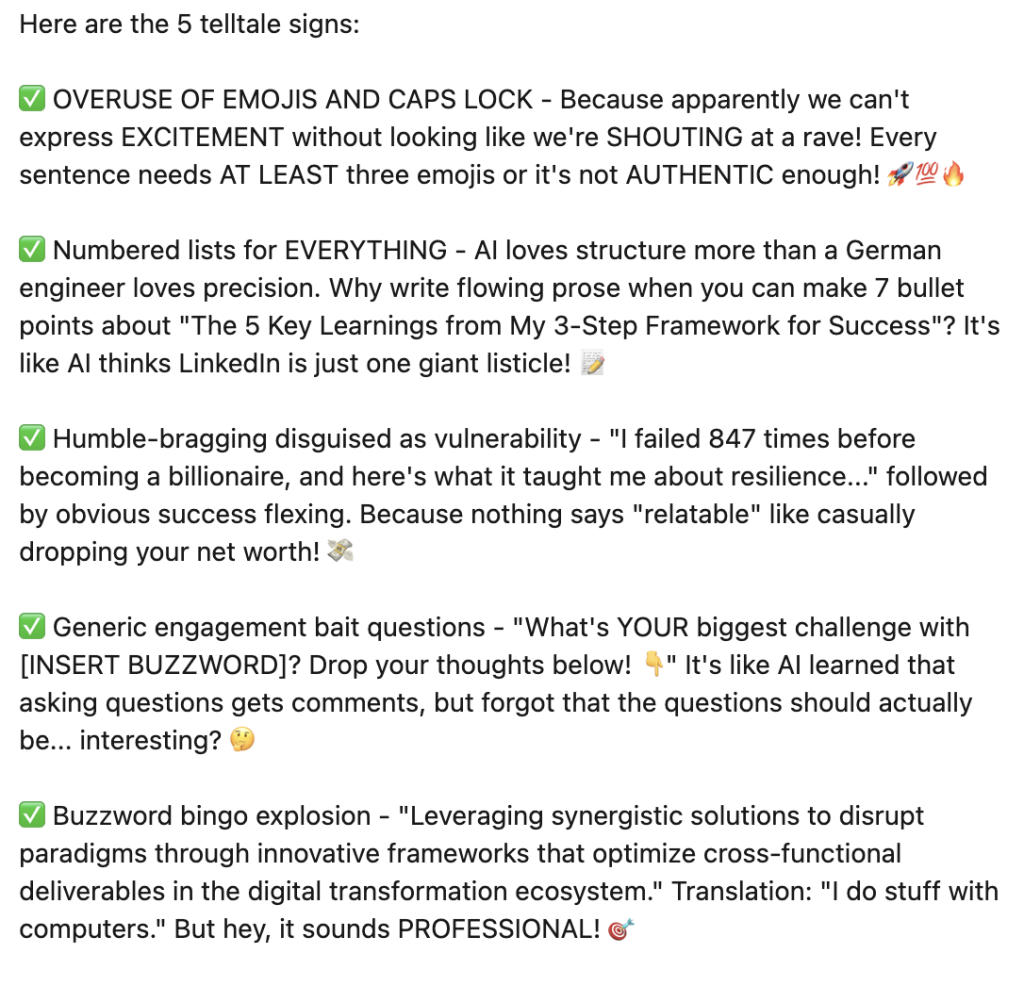
Phrases like ‘We’re thrilled to announce…’, ‘At the end of the day…’, ‘Now more than ever…’, and ‘In today’s fast‑paced digital landscape…’ pop up again and again.
linkedin-post-share-7369472578651934722-Vt8X/
On LinkedIn, AI posts are often full of vague advice: ‘Lead with empathy’, ‘Trust is key’, ‘Communication is everything’, with no examples, no story, and no point of view. It reads fine. It says nothing.
4. Too perfect a structure
AI loves structure. It’s actually obsessed.
You’ll see:
- A hook line with a dramatic claim.
- A tidy numbered list or a series of very even paragraphs.
- A neat summary and a generic question at the end: “What do you think? Let me know in the comments.”

linkedin/
Again, there’s nothing wrong with structure. Structure is important. I harp on about the importance of structure when curating a LinkedIn post. Nobody, and I mean nobody, will read a huge block of text, so you need to break it up with plenty of white space and a few emojis for a splash of colour. But when your content looks like it’s been created by Marie Kondo, it can feel oddly sterile.
5. No opinion, no vulnerability, no stakes
Real humans contradict themselves, change their minds, and occasionally say things that not everyone will love.
Come on, folks, who doesn’t love a controversial post? I’ve been known to post a few in my time.
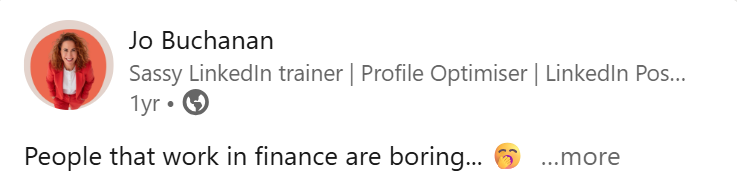
AI content rarely gets controversial. It avoids tension and disagreement. You’ll almost never see, ‘I was wrong about this’, ‘This might be unpopular but…’, or ‘We tried this, and it flopped’.
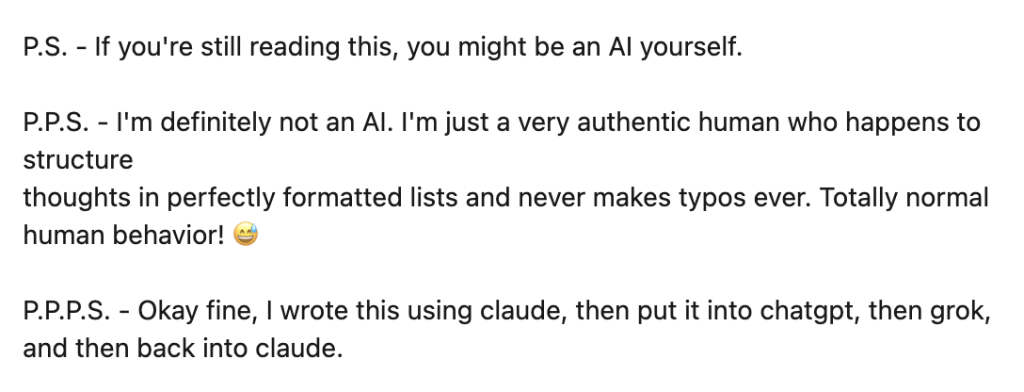
linkedin-post-share-7369472578651934722-Vt8X/
In press releases, AI often comes across as impossibly perfect, even when conveying something difficult. In social posts, it shows up as endless ‘lessons learned’ without any real story behind them.
So… should you stop using AI?
Look, I know I’ve painted AI in a not-very-glamorous light, but it still has its uses. We shouldn’t ban AI forever, but the answer is to stop letting it publish on your behalf without supervision.
In other words, for sweet baby cheeses, please edit the AI-generated content t sound like you.
Yes, AI can:
- Help you brainstorm angles and headlines.
- Turn messy bullet points into a clean first draft.
- Suggest alternative phrasings when you’re stuck.
- Shorten or simplify over‑complicated paragraphs.
But don’t be lazy and just copy/paste what ChatGPT gave you. This is where a little bit of work done by you, personally, will make all the difference:
- Add specifics: names, places, real examples, and local references.
- Remove the obvious clichés and tone down the emoji confetti. 🚀🥑 ☕️ 🍕 🎵 ⚽️ 🌞(sorry!)
- Inject a real opinion, even if that feels a bit uncomfortable. Your readers/followers will thank you for it.
- And finally, but probably, most importantly of all, make sure it actually sounds like you, your firm and your clients’ world.
If your content could have come from any business, anywhere, AI hasn’t ‘saved you tim’”. It’s just made you look like every other lazy sausage out there. And ultimately, your brand will become forgettable.
The winning combination in 2026 is using AI as a support act for your marketing. But we, as humans, should remain the editors and storytellers. Yes, AI can help you move faster, but don’t outsource your judgment, your personality or your reputation to a robot that sounds like everyone else.
There, nuff said.