

Something has shifted in the last few months. For many people at work, artificial intelligence is no longer a tool they occasionally open in a browser.
It is starting to appear inside the systems they already use, attached to the documents they write, the meetings they join and the decisions they are asked to make.
Anyone tracking the major AI providers, including Microsoft, Anthropic, Google and OpenAI, will have noticed the pace of new feature launches picking up sharply. Barely a few weeks go by without a new product name to understand, from Microsoft’s Scout to Anthropic’s Claude Cowork and Microsoft’s separate Copilot Cowork. Each one pushes further beyond the simple chat box most people still picture when they hear ‘AI’.
Several of these supposedly rival products now run on each other’s underlying models. For example, Microsoft has built its newer tools to be model-agnostic, picking whichever engine suits the job, including Anthropic’s. The competition between providers has moved up a level, from ‘whose model is smartest’ to ‘whose product does the most for me with the least friction’.
For businesses, the practical effect is an accelerating stream of new capability that has to be understood, evaluated and, in some cases, adopted faster than most organisations are built to absorb.
The real story is pace, more than any individual product launch. It is easy to talk about AI ‘moving fast’ as a throwaway line, but the practical version of that statement is genuinely difficult to live with inside a business.
An ordinary employee now has to relearn, every few months, not just a new piece of software but a new way of working with it: what to hand off entirely, what to check carefully and what not to trust yet.
IT and admin teams have to keep pace with new permission models, new data access patterns and new governance questions, often before the previous version has even been fully rolled out. Leaders are being asked to make investment and policy decisions about tools that may look meaningfully different again in six months. None of these groups gets the luxury that earlier technology shifts allowed, a few years to settle into a new way of doing things before the next wave arrives. The learning curve has compressed, but the importance of getting it right, particularly around data protection here in Jersey, where our own framework applies rather than UK or European Union rules, has not compressed with it.
There is a reason the learning curve has got steeper rather than flatter. We are no longer just typing a question and getting an answer. The newer tools are built to be pointed at a whole piece of work and largely left to it, which only works if someone has set them up properly first. That means deciding what they are allowed to see, connecting the right data and writing instructions for how a recurring task should be done.
Some platforms call these instructions a ‘skill’, though the label matters less than the work itself. That setup is its own skill, a different and harder one than knowing how to write a good prompt, and right now hardly anyone in most organisations has been taught it properly.
That is where a skills gap opens up, and it should concern any business leader watching this unfold.
Picture two people doing the same job.
One has learned to set these tools up properly. They have written or borrowed a library of instructions for recurring tasks, connected the right data and learned which jobs to hand off entirely, compared with those that need a careful human check at the end. They can set a multi-step research or drafting task running, step away for a coffee and come back to find most of the heavy lifting done. It still needs checking, not blind trust, but much of the work is complete.
Their colleague, doing the same role, is still treating the AI as a slightly better search engine: one prompt, one answer, repeat. Both are working hard. One is producing more output, with higher consistency and more time left over to think rather than type. That gap did not exist eighteen months ago, when the only real skill was knowing how to write a clear prompt. It exists now because the tools have become more powerful and more demanding of skill at the same time.
The obvious business response is to go and hire the first person, the AI-fluent operator who can run several of these tools at once and orchestrate complex work the rest of the team cannot yet touch.
This feels like the wrong instinct, or at least an incomplete one. It treats a skills gap as a hiring problem, when for most organisations it is a training and investment problem, and a faster-moving one than anything we saw with previous waves of workplace technology.
Cloud computing changed where systems were hosted and managed, and with it, changing how the IT department worked. The early wave of ‘Copilot as autocomplete’ changed how quickly people could draft, summarise or improve familiar content. Neither fundamentally changed what an ordinary employee needed to do day-to-day to stay effective in their own role. This wave is different. Using these tools well requires people to learn how to set them up, supervise them and sense-check their outputs. That requires a different and harder skill than phrasing a good prompt, and it will not stay optional for much longer.
That comes with a cost. Real upskilling, not a one-hour lunch-and-learn but genuine, sustained investment in helping people understand what these tools can and cannot be trusted with, takes time, money and patience. It is tempting to skip that investment, especially with AI budgets already under pressure to show quick wins. But skipping it is not a neutral choice. It means the skills gap is decided by the ones who happen to be curious enough to figure these tools out on their own, while everyone else is left to catch up unsupported, or does not catch up at all.
It could be argued that is a short-term saving with a long-term cost: a workforce split between a small group of AI-confident specialists and a larger group whose skills are not being developed at the same pace.
We have not yet fully reckoned with how unusual this moment is. Tools that change how fast a senior consultant or analyst can think and produce, not just how they file or communicate, are rare. Yet, here they are, arriving faster than almost any technology shift anyone can recall in this industry. The honest question for any business leader is not whether to adopt these tools, it is which of three positions you want to be in when the gap has properly opened:
- A business that did nothing and let the skills gap happen by accident
- A business that hired its way out with a small AI-fluent group and left the rest behind
- A business that chose, deliberately and with real investment, to bring everyone along.
Which of those describes your organisation right now?
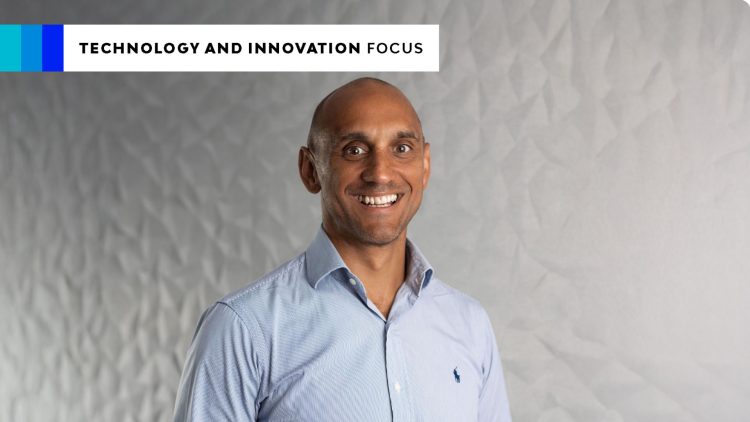
 Marcus Bailey (pictured) is Head of Cloud within the Technical Solutions team at Prosperity 24/7. He joined the business in 2018 and advises organisations on cloud strategy, infrastructure and digital transformation. Established in 2011, Prosperity 24/7 is a leading business and technology consultancy headquartered in Jersey, with offices in Guernsey. The firm helps organisations accelerate digital transformation through strategic change management and technology solutions that deliver lasting business value and better outcomes for customers. For more information, get in touch today.