What can a 630-metre walk along St Catherine’s Breakwater tell us about Jersey’s past? Quite a lot, it turns out, when every metre represents a million years of the Island’s history.
A new five-minute educational film from Jersey Island Geopark takes secondary school students on a journey through 630 million years, exploring how colliding continents, volcanic eruptions, ancient oceans and the Ice Age helped shape the Jersey we know today.
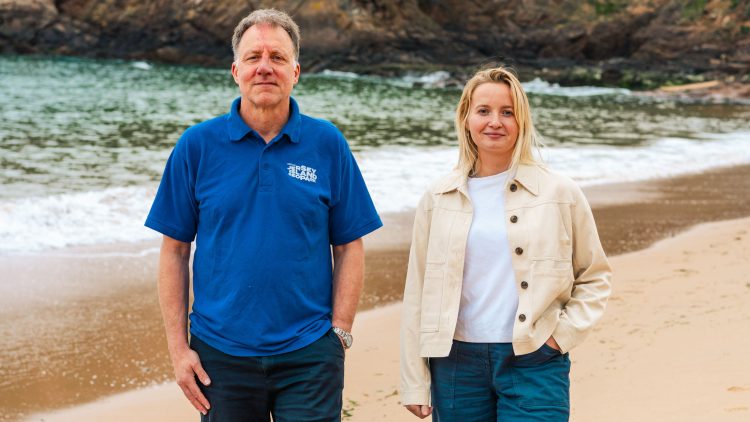
Presented by Dr Paul Chambers, Head of Geopark, and Meg Newstead, Education & Engagement Officer, the film uses the length of the breakwater as a giant timeline, bringing the Island’s geological history into perspective.
Along the way, viewers are taken to locations across Jersey where evidence of its changing landscape can still be seen.
At Sorel, rocks dating back 630 million years reveal how Jersey was formed during mountain building on the edge of the ancient supercontinent Gondwana. At L’Etacq, ripple marks preserved in the rock provide clues to a time when the Island lay beneath a deep ocean.
The journey also explores Jersey’s volcanic past, with evidence of lava and ash eruptions at Anne Port dating back around 583 million years, and the formation of the Island’s granites as magma cooled deep underground.
At St Catherine’s, the Rozel Conglomerate tells a different story, of flash floods sweeping rounded pebbles across an ancient, dry landscape around 500 million years ago.
The film also explains how hundreds of millions of years of Jersey’s geological history have been lost to erosion, before moving on to the Ice Age and the dramatic changes in climate and sea levels recorded in deposits at Le Pulec.
Perhaps most strikingly, the film reveals just how recently Jersey became an island. Rising sea levels separated it from mainland Europe around 8,000 years ago, a period represented by just the final eight millimetres of the breakwater timeline.
Dr Chambers said: “Jersey is a living classroom. Every beach and headland holds a chapter of a story that spans hundreds of millions of years. We want every young person on the Island to be able to read that story and feel proud of the extraordinary place they call home.”
Designed for secondary schools, the film supports Key Stage 3 and 4 learning in subjects including plate tectonics, the rock cycle, coastal processes and climate change. It is accompanied by an animated geological clock, an interactive tool designed to help students understand the enormous timescales involved.
Sally Wellburn, Geography teacher at Jersey College for Girls, welcomed the new resource: “The video provides a comprehensive and engaging overview of Jersey’s geological history. Set alongside the global context, it enables our students to gain a deeper appreciation of the significance of Jersey’s geology. Our teachers are very proud of our relationship with Paul and Meg at Geopark Jersey and we’re excited to continue working with them in future.”
Pictured: Dr Paul Chambers and Meg Newstead