A monitoring programme is easy to describe and hard to show.
Amir Isaac of Guernsey’s Amoreg sets out the six questions a usable programme answers, and where software helps.
A compliance monitoring programme should make it possible to show what was tested, what was found and who decided what to do about it. When plans, test results and remedial actions sit in separate places, answering those questions takes extra work.
Keeping the plan, results and decisions connected can help a team explain its work to a regulator, auditor or board.
What monitoring is, and what it is not
Compliance monitoring is how a firm checks, on a schedule and with evidence, that it is doing what its rules and its own policies say. The compliance function tests the business, records what it found and follows each gap until it is closed.
It is not the day-to-day checks the business runs on itself, and it is not internal audit, which reports independently to the board. It is also not transaction monitoring, the systems that score payments and customer activity for suspicious patterns. The two are often confused when firms go looking for software.
The six questions
A compliance monitoring programme is the written plan for that work. A usable one answers six questions.
1. Which obligations apply?
Start from the rules the firm is actually held to: its regulator’s handbook or codes, the law behind them and its own licence conditions. A programme copied from a firm with different permissions tests the wrong things.
2. Which carry the most risk?
Most programmes are risk-based. Areas such as customer due diligence or client money are tested more often and more deeply than low-risk ones. Write the reasoning down, so the board and the regulator can see why.
3. What will be tested, and how often?
Name the test, not the topic. “Review a sample of new client files against the due diligence procedure, quarterly” can be done and evidenced. “Monitor CDD” cannot.
4. Who tests it?
A name or a role, with enough independence from the work being tested.
5. How are results reported?
Decide in advance who sees the findings and when, so that a problem does not wait for the annual report.
6. How are gaps fixed and rechecked?
Each finding needs an owner, a date and a later check that the fix worked. A programme that finds problems and loses track of them is worse than it looks on paper.
Set a review schedule suited to the firm, and revisit the programme when its rules or business change. Check the requirements that apply to the firm before setting that schedule.
Where it goes wrong
Consider what happens when the steps are disconnected. The rule changes and the test does not. A finding is raised and nobody is named to decide it. A policy is updated and the reason is not recorded, so the next reviewer repeats the work.
Following regulatory changes can take particular care for firms operating across the islands. A firm needs to follow the regulators that apply to its own permissions and activities, with publications appearing on different pages and in different formats. Somebody has to read them, decide what applies and connect the change to the policies it touches.
Where software helps, and where it does not
Compliance software is several different products that share a name. Client onboarding, regulatory monitoring and policy review serve different needs. Check which of those jobs a product supports before comparing it with another.
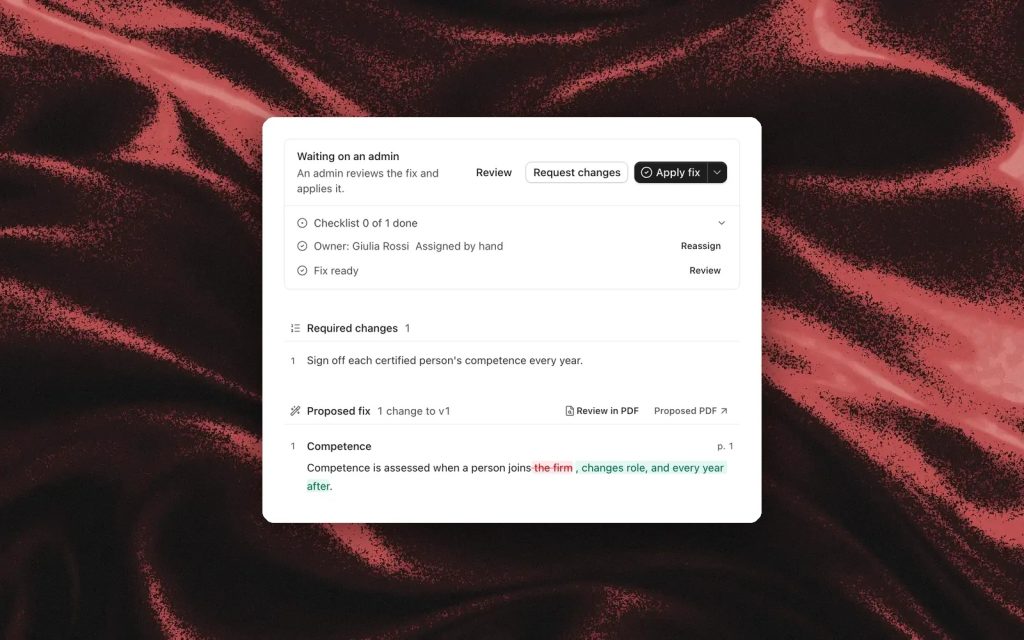
Amoreg does the monitoring job. It watches the regulators a firm chooses and logs each publication with its kind, stage and dates. It reads the firm’s policies against the rules the firm answers to and raises findings where they fall short. Each finding has a severity, a drafted fix and a named person who decides, and the file keeps who decided and when. The software proposes. A person decides.
We are a Guernsey company, and we work from the published rules of the Guernsey and Jersey Financial Services Commissions and the Isle of Man Financial Services Authority.
A template to start from
We have published a free compliance monitoring programme template, built around the six questions above, that a firm can copy and adapt.
It is free to read without registering, alongside a plain guide to the kinds of compliance software sold in the Channel Islands and what each is for.
 Amir Isaac is co-founder of Amoreg Limited, which builds an AI compliance workspace for financial services. Amoreg Limited is registered in Guernsey (company number 74168). You can find the free compliance monitoring programme template here or contact Amir for more information.