

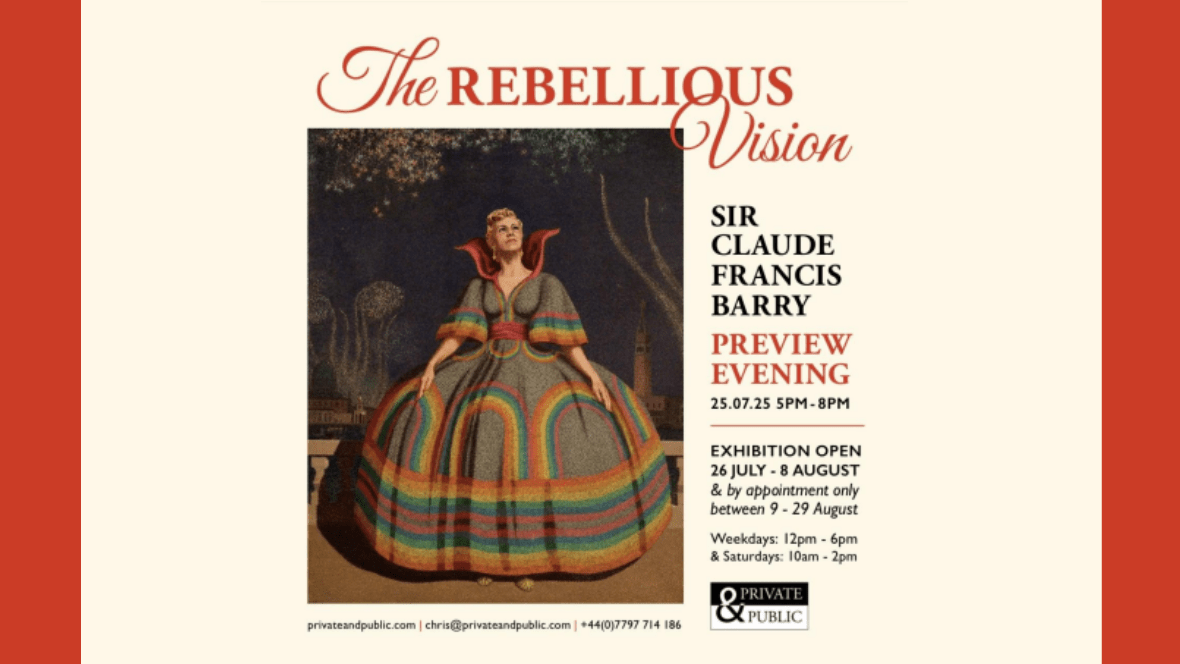
Sir Claude Francis Barry exhibition: The Rebellious Vision
Sir Claude Francis Barry (1883-1970) stands as one of the most enigmatic and unorthodox figures of British art in the 20th century.
A man born into privilege and expectation. Educated at Harrow and destined for social decorum, Barry chose instead a path of fierce independence, aesthetic experimentation, and personal defiance. His long, complex career reflects not merely the restless wanderings of a painter, but the relentless search of a rebel who refused to conform to artistic or societal norms.
Barry’s rebellion began quietly, aristocratically and ended in Jersey where he lived between 1957-1970.
Rejecting the expected path of genteel amateurism, he pursued rigorous training under Sir Alfred East and tutelage at the Académie Julian in Paris. But where many of his contemporaries remained tethered to Edwardian sentimentality or the linear formalism of academic realism, Barry charted his own course, adopting and adapting Pointillism at a time when it was considered a foreign curiosity in British circles.
His early works, especially those created in continental Europe, show a remarkable commitment to technique yet resist slavish imitation of Seurat or Signac. Instead, Barry made Pointillism his own; bolder, more architectural and suffused with a mystical or melancholic light. These were not exercises in colour theory but meditations on solitude and structure, dreamscapes built dot by dot.
That sense of artistic isolation would deepen throughout his life. Barry’s move to St. Ives in Cornwall in the 1930’s placed him in proximity to modernist ferment, but he remained somewhat aloof from the cliques and critical trends of the day. Never fully embraced by the art establishment, Barry’s work straddled the line between tradition and innovation.
He painted in series, often obsessively recording cityscapes of Venice, haunting war memorials, eerie nocturnes of rooftops and empty squares. Even when engaging familiar themes such as cathedrals, bridges and canals, he rendered them with a spectral detachment that eschewed romanticism.
His world was ordered yet unstable, shimmering with both harmony and disquiet. This duality reflects Barry’s inner rebellion, a refusal to settle, to belong or to compromise. His life was punctuated by personal upheaval, the trauma of the First World War, the loss of his first wife, estrangement from family, bankruptcy and displacement.
Yet these events never broke his artistic spirit and they seemed, in fact, to deepen his resolve. In the 1940’s and 1950’s, as abstraction gained dominance, Barry continued painting in his precise and meticulous style. This was not mere conservatism but resistance, a commitment to his own vision regardless of fashion or critical approval.
Barry’s later years, spent in Jersey and Sussex, were marked by increasing eccentricity and defiant solitude. He painted prolifically into old age, developing a series of deeply psychological and at times troubling self-portraits that verge on the surreal. Gone were the dreamy vistas of his youth and in their place stark reflections on mortality, identity and alienation. These works, often overlooked in favour of his more decorative scenes, represent the culmination of Barry’s rebellious trajectory, an artist who dared to look unflinchingly inward. In a century that celebrated revolution in art, Barry was a quiet insurgent. He did not align himself with manifestos or movements, nor did he seek celebrity.
Instead, his rebellion was rooted in an obstinate fidelity to personal truth. He lived on the margins of society and of modernism, yet from that marginality emerged a body of work that continues to haunt and captivate.
To view Barry’s oeuvre today is to encounter not just a painter of immense technical skill but a man who refused to conform, who found beauty in defiance and clarity in solitude. He reminds us that rebellion is not always loud or flamboyant. Sometimes it requires a long and slow persistence, a lifetime of saying no to compromise and yes to vision.
I hope you enjoy the exhibition for these paintings and etchings are some of the finest and most expensive works ever to be shown at Private & Public Gallery.